Hi, families with young babies. This one’s for you! Giving someone their first real taste of food can be daunting. Let’s break it down and make it a process you can cherish and not fear.
When is the best time to begin your baby on solid foods?
Most sources indicate four to six months as a good period to begin solid foods. I lean toward six months because the digestive tract becomes more fully developed at that age and better able to break down solid foods. Six months is also the time that your baby may start needing higher amounts of some nutrients such as iron and zinc. Adding solid foods at this age can help achieve this.
How do I know my baby is ready for solid foods?
Once your baby has hit that four to six month mark, check for signs that they are ready for solid foods. All babies progress at their own rate. Look to see if your baby is sitting up on their own, starting to use a pincer grasp and if they are showing interest in foods. Is your baby eyeing what you eat? Are they trying to grab food from you? Does your baby have teeth? All of these can be indicators that they are ready for solid foods.
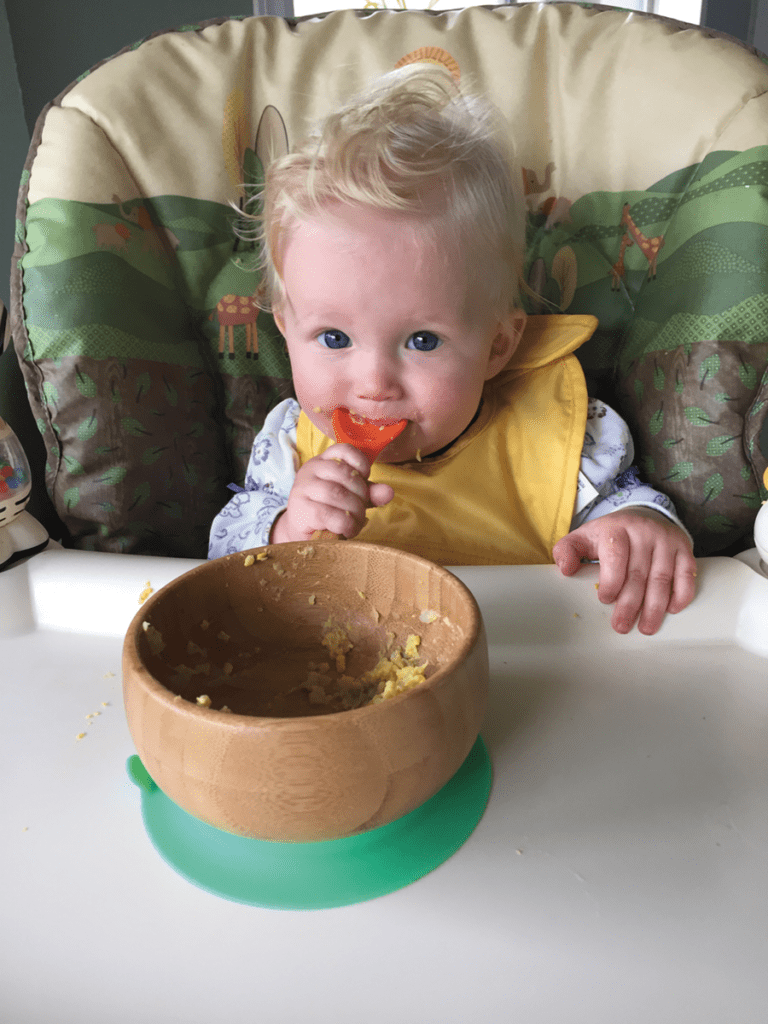
Let your baby lead the way and don’t insist. Open mouth means “Yes, yum.” Closed mouth or turned head means “No, I’m full” or “No, I don’t like that.”
What food do I start with?
There is no one perfect food. Choose real food and make sure the size and texture are appropriate for your baby. What is appropriate for each baby varies, so observe how your baby maneuvers food. There are two popular food introduction techniques: baby-led weaning (BLW) and the more traditional pureed or soft foods on a spoon. I like both and have used a combination of the two styles. BLW focuses on providing your child with foods they can feed to themselves, typically a steamed vegetable or fruit sliced in a wedge so they can pick it up and take bites. Most of the recommendations below offer both versions.
Avocado
Bring on the healthy fats for brain development, the fiber for proper gut function and the creamy softness that makes it easily palatable. Mash and offer on a spoon or place a slice in front of your baby to encourage them to feed themselves.
Steamed Carrot or other steamed vegetable
Steam until vegetable is easily mashed with the tongue.
Offer mashed on a spoon or whole for your child to pick up.
Peas
Soft peas give your baby opportunity to practice picking up their food.
Banana
Mash and offer on a spoon or slice in half and quarter lengthwise for your child to hold.
Egg yolk is a good source of iron and choline. Hard-boil an egg, eat the white and save the yolk for baby. Mash the yolk up and mix in breast milk or water until the texture is no longer dry. Serve on a spoon.
Scrambled Egg
Scramble a whole egg in butter or coconut oil. Serve on a spoon or in small pieces they can pick up.
Pureed Meat
Use a blender or food processor to puree cooked meat. Add in breast milk, formula or water to achieve a soft texture.
Things to observe once you begin offering food
Does your baby push the food out of her mouth with her tongue? This reflex may indicate that your baby is not quite ready for solid foods. Does your baby cough or have trouble gumming the item you offered? If so, try a different size, make the food softer or try a different food item next time. If your baby is feeding himself, does he take bites or shove the food item in all at once? Too much food in the mouth can be difficult for your little one to maneuver.
You may want to try different techniques to regulate intake at the beginning, like offering only one bite at a time or offering on a spoon, so that you control the amount. Serving sizes don’t need to be large for your baby to get the benefit of solid foods as most of their nutrition will still be coming from breastmilk and/or formula.
It’s OK if your baby would rather explore the food you offer than eat it. This is all new and your baby will progress in eating at their own pace. Feel confident taking cues, such as your baby pushing a food offering away. This can indicate that they are full or not ready for solid foods yet. Enjoy providing your child exposure to new foods and learning with them.
Posted in: Family Life & Support, Parenting

Comment Policy: All viewpoints are welcome, but comments should remain relevant. Personal attacks, profanity, and aggressive behavior are not allowed. No spam, advertising, or promoting of products/services. Please, only use your real name and limit the amount of links submitted in your comment.
You Might Also Like...
From One Dad to Another: Partnership Over Pressure
Watching my young son discover the world—the way his eyes light up when he figures out how to stack blocks or the concentrated furrow of his brow as he works […]

From Chaos to Gratitude: Survival Tips for New Parents
Delighted, anxious, excited, tired – congratulations on being a new parent! The reality is that sometimes parenting can feel like survival, other times it is the best feeling in the […]
Camping Tips for First Timers
Avoid SNAFUs and smooth the way with these “campwise” tips from The Campout Card Deck by Marnie Hanel & Jen Sevenson. Pack Planning Prepare for the worst weather by choosing […]

From One Dad to Another: Being Your Child’s Safe Harbor
I sit with men every day who talk about their deepest struggles—anxiety, depression, years of buried emotions. Often, these conversations circle back to a common thread: “I wish my father […]