The Abacus Project
Instilling a Love of Math at an Early Age
The Abacus Project was established after several early-childhood based organizations in Siskiyou County, in partnership with the Ford Family Foundation, came together to implement a program that would not only give young children the skills they need to prepare them for kindergarten, but would empower parents and caregivers to help them achieve those skills. The Ford Family Foundation, located in Roseburg, Oregon, makes grants to public charities benefiting communities in rural Oregon and Siskiyou County, California. The goal of the Children, Youth and Families department “focuses on the youngest members of our rural population, prenatal to age 18. We work with partners, grantees, families and rural communities to support kindergarten-readiness efforts — prenatal until a child enters school, ready to learn,” as stated on the Ford Family Foundation website.
 According to Christy Cox, Early Childhood Development Senior Program Officer for the Ford Family Foundation, “The Abacus Project was a successful, community-designed and -led project that put age-appropriate math information and materials into the hands of parents and children.” She also emphasized that, “Research about early childhood development shows that math knowledge and skills at kindergarten entry are strong predictors of later school success.”
The project went through the planning phases in 2014, was launched in 2015 and concluded in the spring of 2017. Families have long been encouraged to expose their children to books to foster reading and literacy skills, but a question that the planning group asked themselves when collaborating on this project was, “What if we put math materials in the home?”
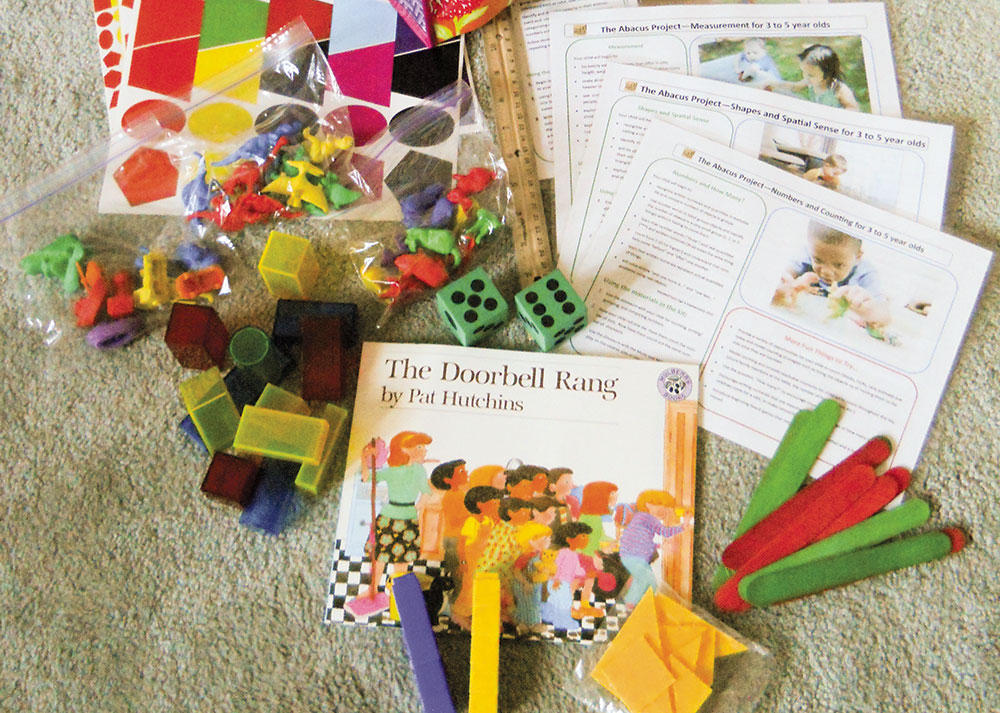
Free kits to inspire a love of math were designed and put together by College of the Siskiyous in collaboration with local groups such as First 5 Siskiyou, Siskiyou Childcare Council, Early Head Start and Karuk Head Start. During the course of the project, almost 2,000 Infant and Toddler and Pre-K Abacus kits were distributed to residents of Siskiyou County through county fairs, preschool sites, family resource centers, childcare centers, the college and other venues.
Workshops were held at several sites to introduce and educate parents, caregivers and early childhood professionals on how to use the kits with the children. There was also a one-credit course offered at College of the Siskiyous that used the Abacus content and kits to teach about young childhood math development. The kits consisted of toys and manipulatives that would introduce and teach the concepts of measurement, numeracy, patterns, spatial concepts and shapes.
The Infant and Toddler kit included items such as measuring cups, board books, blocks and toy ducks, while the Pre-K kit for ages 3-5 had items like dice and rulers. Tangrams, which are dissection puzzles consisting of seven flat shapes, called tans, that are put together to form other shapes; and stackable Unifix cubes were also a part of the age 3-5 kits. Both kits also included age-specific activity cards for parents and caregivers to help them teach concepts to the children.
Cox pointed out that although the Abacus kits benefited families of young children, there is no need to spend a lot of money on learning materials to teach math concepts to young children. If you had to pick one toy, she advises, “my number one recommendation would be to invest in a set of blocks.” Otherwise, parents can integrate math lessons into everyday situations such as going grocery shopping and counting items to put into the cart, or for older children, teaching money concepts. Everyday household items like empty boxes and recycled lids can be used to introduce math concepts such as “bigger versus smaller”, and “more versus less”.
Beyond the project itself, Cox has “hopes for some elements moving forward.” The activity cards which were included in the Abacus math kits are in the process of being updated, bound into small books, and will come in two versions: Infant and Toddler, and Pre-K. These booklets will be made available to Oregon and Siskiyou County residents on the Ford Family Foundation’s Select Books website. They will also be available in downloadable PDF form for people outside those areas. Cox says she hopes to have them available by early 2018.

Comment Policy: All viewpoints are welcome, but comments should remain relevant. Personal attacks, profanity, and aggressive behavior are not allowed. No spam, advertising, or promoting of products/services. Please, only use your real name and limit the amount of links submitted in your comment.
You Might Also Like...
North State Symphony: Healing Hearts through Music
In the summer of 2018, when the Carr Fire ravaged communities around Redding, CA, North State Symphony (NSS) musicians immediately got on the road. Driving through miles of ash and […]

The Redding Ducky Derby Becomes The Sundial Riffle Raffle
What happened to the Redding Ducky Derby? It has been reimagined as the Sundial Riffle Raffle taking place this year during the River Bowl, Friday, October 18. Since the inception […]
We’re Off To The Theatre
Experiencing the arts with young children in a theater setting will be much more enjoyable if you take some time to prepare beforehand. These simple tips will help make the […]
The Bond Between Grandparents and Grandchildren
Grandparents Day is September 9th, but smart parents regularly celebrate the vital role that grandparents play in their family’s life every day. The strong bond between grandparents and their grandchildren […]