In 2010, the united efforts of local parents, teachers, and community members resulted in Wildflower Open Classroom, a free public school serving kindergarten through 8th grade in Chico, CA. Rising from holistic education philosophies like Montessori, Steiner, Piaget and Dewey, the open classroom already had a rich, 40-year history. Thirteen years later, Wildflower still offers North State families empowering and engaging education through hands-on learning.
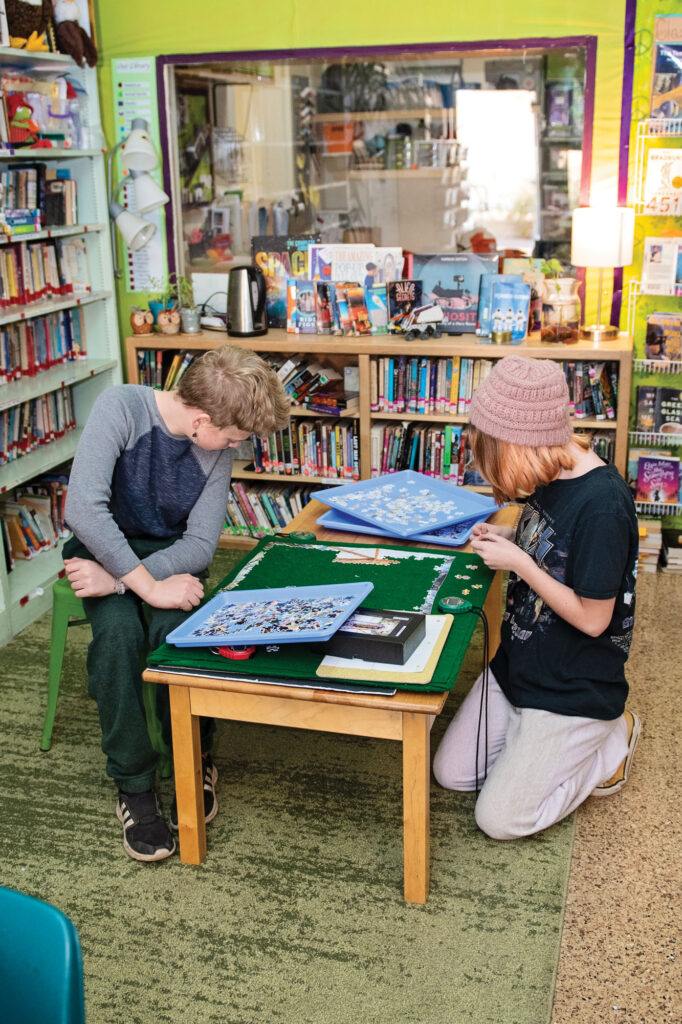
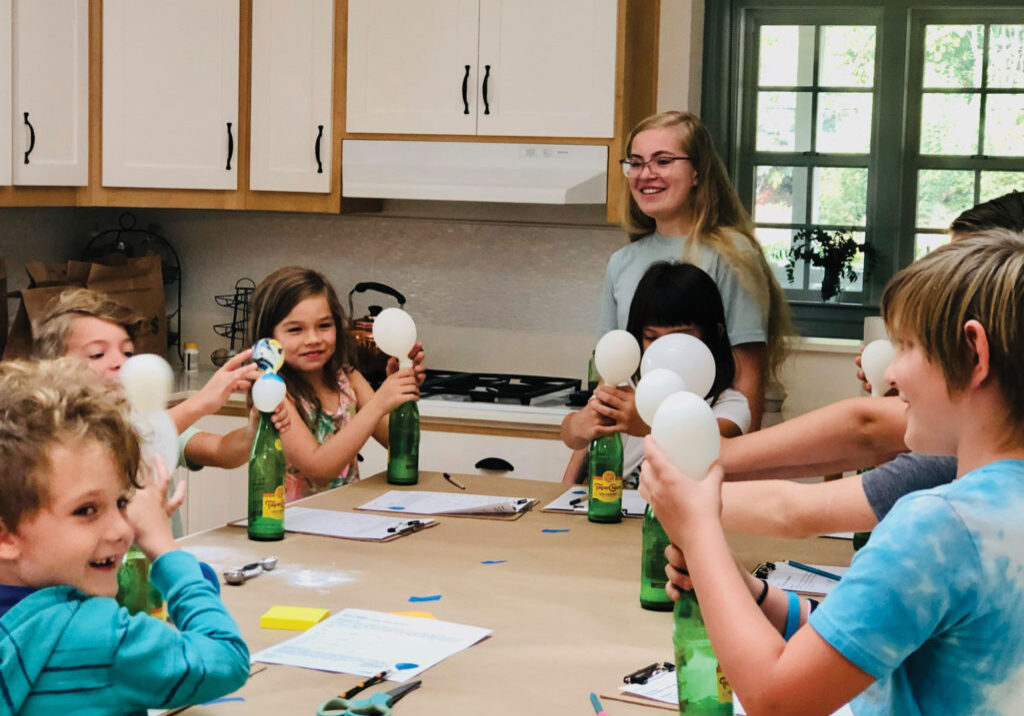
The phrase “open classroom” describes Wildflower’s approach to the physical learning environment. Without rows of desks, Wildflower classrooms literally have more open space. Depending on the teacher, students might sit on a carpet or an exercise ball in a classroom, but the goal is always the same: to encourage students to move around, physically engaging in their learning by accessing materials throughout the room. The open space also invites more collaboration and hands-on instruction in small groups or as individuals.
Interdisciplinary education connects every subject to others
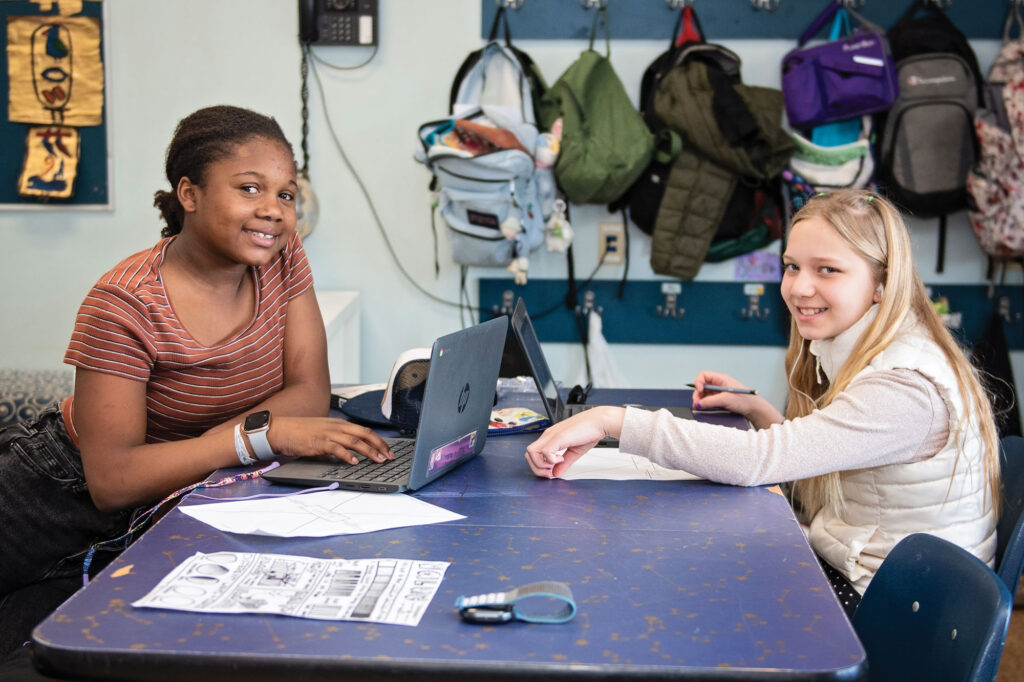
“Open classroom” also means that Wildflower’s programs are open to students’ interests. This happens through “interdisciplinary education.” While most mainstream education isolates each subject – students learn math in math class, history in history class, etc. – interdisciplinary education recognizes that every subject connects to others.
For example, math does not occur in a vacuum, but serves as a building for science. Science affects society through medical and technological advancements that shape history, which in turn influences what people read and write about. Because it is all connected, students can approach a given topic from their angles of interest, empowering them to choose what interests them and engage more deeply in their learning.
“Whenever possible, we like to give students choices,” says Wildflower teacher Linda Holm. “We’re really trying to accommodate for individual students because everybody learns differently.” Linda says student progress is measured by teacher observation, project-based rubrics, tests, and assessments. “Our students have to meet state and district standards just like any other school and classroom. It’s just we go about teaching those things differently than other classrooms do.”
Thematic lessons help bring purpose to learning
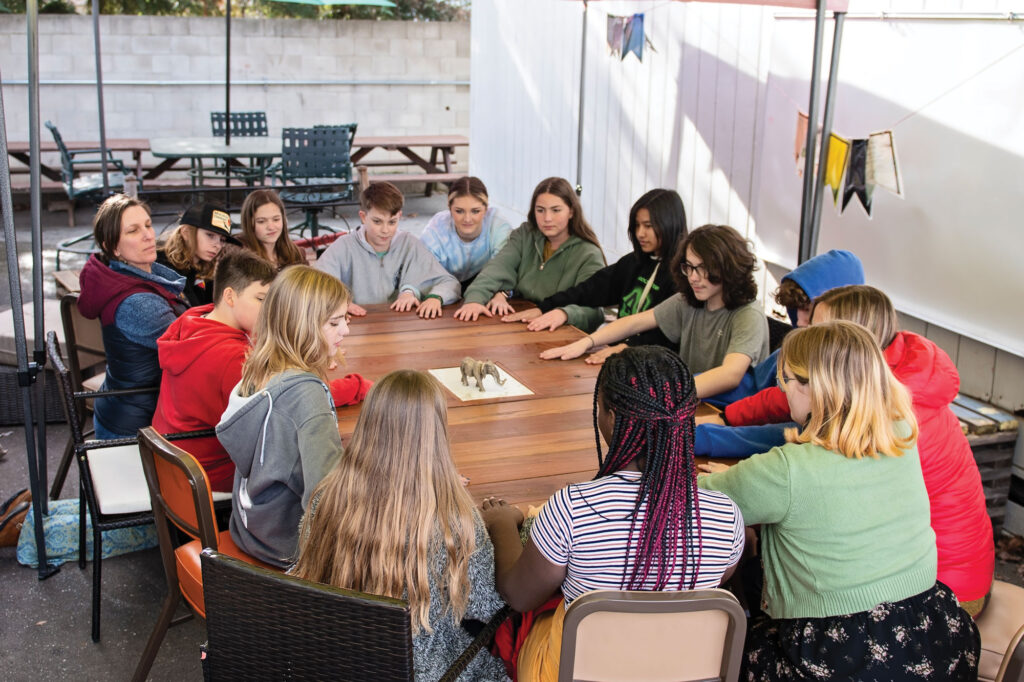
Interdisciplinary education happens largely through thematic lessons. Linda, who has taught for 43 years, has chosen a space theme this year: “Universe, Us, and the Unknown.” Within this theme, Linda’s 5th and 6th grade students have researched the history of NASA’s Apollo missions, studied the science of Newton’s laws of motion, and experimented with building model rockets. They have painted pictures of Earthrise, humankind’s first image of our planet from space, and learned about nuclear-powered spacecraft. They have written letters to Nicole Mann, the first Native American to launch into space, and entered a NASA-sponsored writing contest. The class watched the Artemis rocket take off on November 16, 2022, and drew diagrams of its launch path. In this context, learning scientific principles, mathematical functions and writing skills becomes highly purposeful and engaging.
Photos by Amber Thompson
A more mature approach for older students
Bethany Dorin and Melissa Macdonald teach seventh and eighth grade students in the Wildflower Open Classroom Adolescent Program (WOCAP). While the principles remain the same for older kids, the approach becomes more mature.
“We’re wrapping up a six-week unit on the theme of identity,” explains Bethany, who teaches science, English and history. Through the identity unit, her students have studied the science of genetics, learned the history of several immigrant movements, read the autobiography of a 1950s Mexican immigrant; and written related essays, reflections and poems. “We’re learning all kinds of things that are definitely aligned with state standards,” Bethany explains, “But they’re posed in a way for the kids that is more playful and interesting.”
Wildflower lessons are developing life skills
On top of engaging students and preparing them to meet state standards, Wildflower’s lessons also develop life skills. Bethany’s identity unit includes considering current identities and future goals, which has led to exploring internships and writing resumés. This life-skills training, Melissa says, starts young at Wildflower. Melissa’s daughter, a third-grader at Wildflower, has already begun taking charge of her own time management. “She’s thinking ahead, like, ‘I have this goal; I want to participate in something on Friday, so I need to get things done before then,’” Melissa says. “There’s accountability, responsibility, and natural consequences. It kind of mimics the real world.”
As they prepare for the real world, the open classroom approach awakens the natural curiosity of youth, which grows into self-motivation – one of the best keys for students’ future success. With open classrooms and open minds, Wildflower students can anticipate opening many doors of opportunity in the North State and beyond.
Posted in: Education
Comment Policy: All viewpoints are welcome, but comments should remain relevant. Personal attacks, profanity, and aggressive behavior are not allowed. No spam, advertising, or promoting of products/services. Please, only use your real name and limit the amount of links submitted in your comment.
You Might Also Like...
Blue Oak Equity & Anti-Racism Task Force Reevaluates Curriculum
Racial inequity and historical narratives As a Waldorf school, Blue Oak Charter School in Chico, CA has always relied heavily on historical narratives from around the world to communicate history, […]
Homeschooling Moms Answer Common Questions
Since the pandemic began, veteran homeschooling families have gotten many requests to tell others how they manage. We recruited seven local homeschooling moms to help answer some of the common […]
Easy Ways To Build Up STEAM At Home
STEAM (Science, Technology Engineering, Arts and Math) has grown in popularity in recent years as a way to educate children for the contemporary world and future jobs. You can foster […]
The Montessori Method: An Approach To Educating The Whole Child
What do Anne Frank, Julia Child, Prince William of England, Jeff Bezos (founder of Amazon.com), and rapper Sean “P. Diddy” Combs have in common? Although vastly different in their life […]