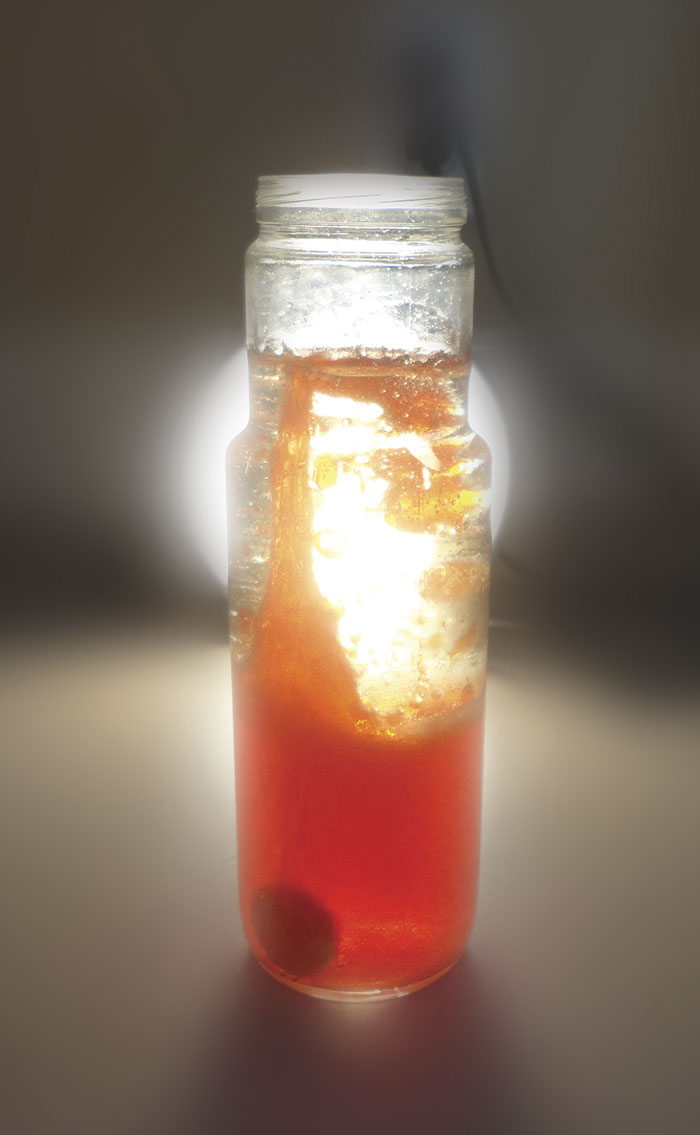
 Liquid motion lamps, more commonly known as Lava lamps, are cool things to stare at for hours. Learn to make a simple version (without the cool lights) and learn about the science behind this model as well as the original lamps invented in 1963.
Materials:
An empty glass bottle (preferably one with a wide mouth for dropping something into it), water, oil, food coloring, Alka-Seltzer tablets. Extra: glitter.
Procedure:
- Fill a glass bottle halfway with water
- Put an equal amount of cooking oil in (make sure to leave some space near the top)
- Drop some food coloring into the bottle and watch it slide through the oil until it hits the water and then mix together
- Add some glitter to the liquids if you want!
- Place a light behind the glass bottle if you want to see more clearly
- Drop the Alka-Seltzer tablet into the bottle and enjoy watching what happens
Explanation:
A lava lamp works because it has two liquids that don’t mix together. An actual lava lamp uses water and wax. The lamp inside heats up the wax until it melts then it becomes slightly less dense than water and will float up. When it cools down, it gets denser and then sinks. The process repeats.
This homemade version relies on two liquids, oil and water, that also don’t mix. The water has a greater density than the oil and sinks. (Density is a property of matter that shows how much stuff is in a space. Metal has a big density… really heavy for its size!).
When the tablet bubbles in the water, it makes the water less dense, in a sense, so it floats up to the top of the oil. When it gets there, the air escapes and the water, denser again, sinks to the bottom.
Experiment further:
Good scientists think of questions they can ask and ways to change a system. Can you? How about if you change the size of the container? The size of the tablet? The number of tablets? What if you put more oil in than water? Ask a question and test it out! If you are using this as something to show a teacher at school, write down some observations you make.
I hope you enjoyed this simple experiment and learned a little bit about science. Contact me if you have questions about this, or need tips about science fair ideas around this topic (or others).
Posted in: Education

Comment Policy: All viewpoints are welcome, but comments should remain relevant. Personal attacks, profanity, and aggressive behavior are not allowed. No spam, advertising, or promoting of products/services. Please, only use your real name and limit the amount of links submitted in your comment.
You Might Also Like...

How to Talk to A Teacher
A meeting between you and your child’s teacher can be a powerful tool for helping your child succeed in school. Whether scheduled by the school, requested by you, or suggested […]

Four Myths about Trade Schools
“Our American culture wants each generation to be better than the last,” says Tracy Lokstadt, president of The Trade School at Shasta Builders Exchange, a non-profit trade school in Redding, […]

Start Strong: Fun Ways to Celebrate Teachers at the Beginning of the Year
When was the last time you thanked a teacher? So often we go about life, grateful for their hard work, but we never really stop to thank them for the […]
Copernicus Tutoring
Shasta High School Seniors Offer Free Tutoring For Peers Over the summer, Lily and Leah created a tutor application process, built a website, and recruited tutors for the Zoom-based program. […]