From UC Davis
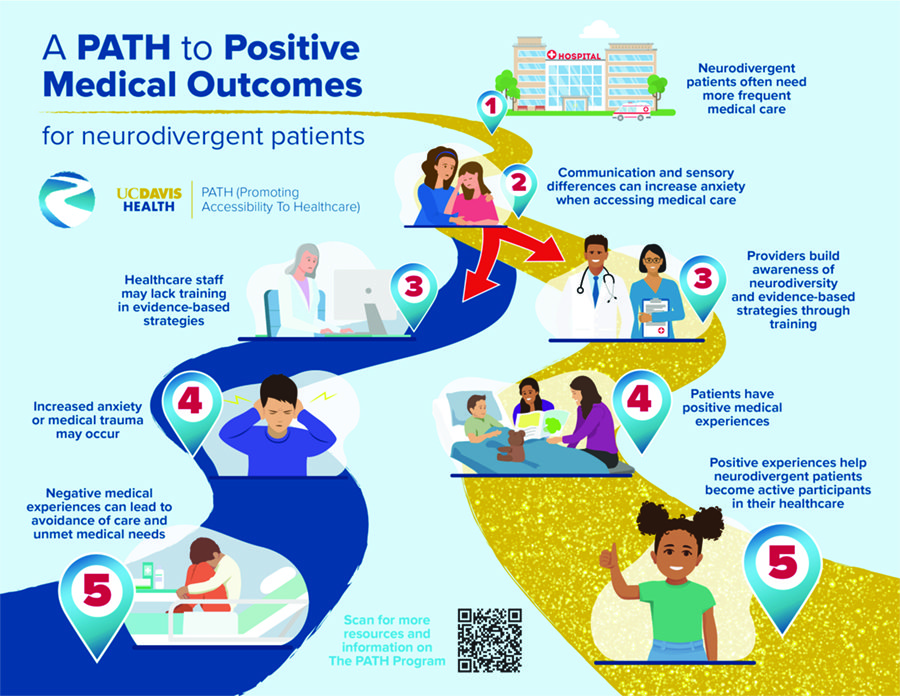
A trip to the doctor’s office or hospital can be challenging for children who have autism and other neurodevelopmental disabilities. In response, UC Davis Health has pioneered a first-in-the-nation program called PATH (Promoting Accessibility to Healthcare) to improve health care experiences for neurodiverse children and their families. The program is funded by a Children’s Miracle Network at UC Davis grant.
“Individuals with disabilities are more likely to have medical trauma that contributes to care avoidance and are four times more likely to have unmet health care needs,” says Scott Akins, chief of developmental pediatrics, medical director of the UC Davis MIND Institute and co-medical director of the PATH Program. “We’re aiming to change this by adapting our environments to better serve those neurodiverse children and their families who need this care.”
PATH is first being implemented at the Children’s Surgery Center (CSC) at UC Davis Children’s Hospital. Over 80% of center staff are trained on the PATH curriculum, making it the first unit in the hospital to achieve PATH certification.
 Making surgery less scary
 Making surgery less scary
PATH employs several strategies to make the surgical experience less scary for children with neurodevelopmental disabilities.
The program starts by getting basic information from families and patients about their likes and dislikes. For example, the program asks the patient how they prefer to communicate with providers. The program also asks patients or their parents
or guardians to share their sensory needs. For some autistic patients, lights that are too bright or loud noises can be unpleasant and painful. For those with previous medical trauma, the sight of lab coats or medical equipment can be upsetting. Changing these elements can be the difference between a successful visit and a traumatizing one.
Once families can identify these preferences, they are added to the child’s medical chart. That way every medical provider can find those preferences. This patient-centered approach helps inform the way that the health care team interacts with the patient each and every time they come for care.
“Trying to create an environment and a set of best practices that lets them have the most effective visit possible is going to create a pattern of success that we think will have lifetime implications,” says Jonathan Kohler, medical director of pediatric trauma, pediatric general surgeon and co-medical director of the PATH program. “That’s what we’re trying to address – not just how we make care better for neurodiverse patients in the moment, but how we make the whole spectrum of care that patients get across a lifetime better.”
Training the team for success
Patient navigator Katharine Harlan Owens says that it starts with the employees, who are now trained and PATH certified. “We have created a corps of skilled and compassionate nurses and technicians who now have the tools to better understand the experience of our neurodiverse patients and provide accommodations that make their visit better,” says Harlan Owens, who in addition to being a PATH navigator is with the MIND Institute’s Center for Excellence in Developmental Disabilities and program manager of the PATH Program.
As part of the PATH certification process in the CSC, other improvements have also been made. These include expanding the selection of sensory items, fidgets and visual distraction tools.
Harlan Owens adds that good communication and advocacy are essential to making the PATH program work. She noted that the PATH Advisory Committee — which includes individuals with lived experience and their caregivers – is critical to the program’s success.
“PATH is a work in progress and we want to know how it is – and isn’t – working for the patients and families that we serve,” Harlan Owens says.
To learn more visit: thepathprogram.org.
Posted in: Health & Nutrition

Comment Policy: All viewpoints are welcome, but comments should remain relevant. Personal attacks, profanity, and aggressive behavior are not allowed. No spam, advertising, or promoting of products/services. Please, only use your real name and limit the amount of links submitted in your comment.
You Might Also Like...
Growing Garden Memories and Good Food At Red Gate Ranch
Two special events in Red Bluff happen each April: The Red Bluff Round-Up and temperatures favorable for summer garden planting. It took much trial and error in our family’s garden […]

How To Be A Fitness Role Model To Your Kids
Our children look up to us for guidance on everything in life, even if we don’t realize it. One way that you can be a positive role model to your […]
Calming the Butterflies
Your child may feel “butterflies in their tummy” if they have a big event coming up such as an important test, a piano recital or even the first day of […]

Heartfelt Health Care For Those Experiencing Homelessness In Redding
“I take care of wounds, drain abscesses, start blood pressure medicine, treat diabetes and treat psychiatric conditions,” says Dr. Kyle Patton, M.D., medical director of the Hope program at Shasta […]