The holy grail of business models is the subscription service. You pay for a service or product month, after month, after month—often even after you no longer want to receive it because you never seem to get around to canceling—until either you or your wallet are completely exhausted, whichever comes first. Subscriptions include your cell phone and internet service, gym memberships, and tangible items like overpackaged delivery boxes for meal kits, Christmas ornament-of-the-month clubs, and throwaway coffee pod-of-the-month clubs.
You may not consider disposable items such as plastic wrap and paper towels as subscriptions, but they essentially are. You buy them, use them, toss them, and then, having grown dependent on them, you must buy more. They may not cost much per package—a couple rolls of paper towels costs only a few dollars—but over time you will spend hundreds of dollars on these, at least. Meanwhile, the alternatives cost very little, if anything.
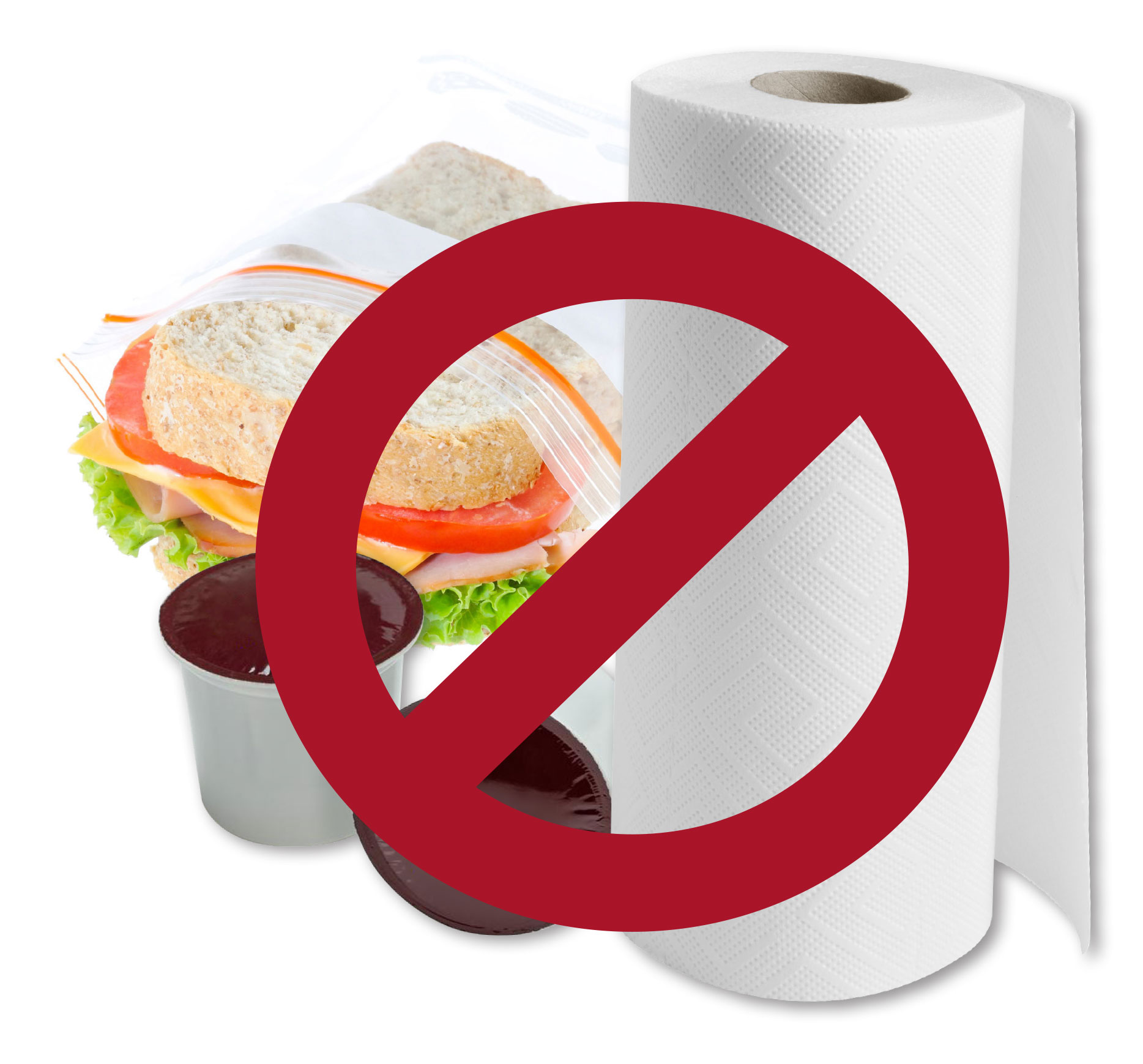
Alternatives to plastic wrap
Want to cover a bowl of leftovers? Put a plate over it. Need to store half an uneaten melon in the refrigerator? Store it cut side down on a flat plate or pie dish. I store onion halves the same way.
Alternatives to plastic baggies
Looking for a way to wrap a sandwich? Try a cloth napkin or use metal sandwich containers or tiffins. The containers cost more upfront, but like other reusable products, they pay for themselves over time because you buy them just once.
In some commercial kitchens, after charring peppers, line cooks then put the steaming hot peppers into a plastic baggie and close it, trapping in the heat and moisture that causes the charred skin to blister. This makes removing the skin with a knife edge very easy. You can skip the baggie and place the hot peppers in a glass, ceramic, metal, cast iron (i.e., just about anything that isn’t plastic) container or a pot with a lid. Or simply put the hot peppers in a bowl and put a plate on top of it.
Yes, washing dishes and containers does consume energy and water. But so do the harvesting, manufacturing, and shipping processes that go into creating each new throwaway product.
Alternatives to parchment paper
You can bring much worse things into your kitchen than parchment paper. I won’t judge you if you cling to your parchment paper—or anything else, for that matter. Some companies make unbleached, home-compostable parchment paper. And you can use sheets several times before composting them. But you also have alternatives to expensive parchment paper for cooking pizzas, cakes, cookies, pastries, and more. For starters, simply grease the baking sheet, cake pan, or baking tin. Yes, you get grease all over your hand. Rub some of that into your skin to help soften your hands. Wipe the rest off with a dish towel rather than a paper towel (that’s a bonus example).
If you roast vegetables and want to avoid scrubbing a metal baking sheet or glass dish but also want to avoid using parchment paper, roast your vegetables in cast-iron pans, if you have them since, as I’ve said, cast iron cleans so easily.
Alternatives to aluminum foil
I love roasted beets and beet pickles. I used to wrap my beets in aluminum foil to roast them in the oven to prevent them from drying out and to keep the roasting dish clean. Occasionally I would save a piece of foil to reuse after unwrapping the beets, but usually I ended up throwing out a bunch of beet juice–covered tinfoil.
Then one day, after I had started to live zero waste, I craved some roasted beets. But how to make them without foil? I wondered if a Dutch oven would work. It did! Had I not imposed the no-foil constraint on myself, I never would have bothered to figure this out. But my beet craving demanded a solution.
Alternatives to coffee pods
No environmentalist worth her package-free salt can write about coffee without the obligatory rant against disposable coffee pods. Not only do they create obscene amounts of waste—Keurig alone sold nearly 10 billion packs of pods in 2014—they also represent the Wall·E-fication of our society.
Can we no longer measure out the ground coffee and boil the water? Will we soon need every foodstuff measured and packaged for the specially designed machines that prepare it for us? Personally, I enjoy the ritual of brewing coffee in the morning—or tea. But you can now buy tea pods as well, surely a sign of the endtimes.
Some aluminum coffee pods can be recycled. The problematic combination of plastic and aluminum of many other pods makes them landfill bound. Theoretically, just about everything, with enough effort, energy, and expensive heavy equipment thrown at it, can be recycled. That doesn’t mean it will be or should be recycled. And besides, recycling is a last resort. Above all else, refuse trash at its source.
For a no-waste method of brewing coffee, which takes all of 5 minutes to prepare a couple of cups, brew in a French press. If you worry you will never recover those 5 minutes of your life, do something productive while you wait for your caffeine hit— put some dishes away, feed the cat, talk to your partner. Toss the spent coffee grounds directly on the soil around your plants outside. My roses especially love the acidic grounds.
For more ideas on reusing, reducing waste and cooking healthier, find The Zero-Waste Chef at bookstores near you and visit Anne-Marie’s website, zerowastechef.com
 Excerpted from The Zero-Waste Chef. Copyright © 2020 by Anne-Marie Bonneau. Photography by Ashley McLaughlin. Published by Penguin Canada, an imprint of Penguin Random House LLC. Reproduced by arrangement with the Publisher. All rights reserved.
Posted in: Health & Nutrition

Comment Policy: All viewpoints are welcome, but comments should remain relevant. Personal attacks, profanity, and aggressive behavior are not allowed. No spam, advertising, or promoting of products/services. Please, only use your real name and limit the amount of links submitted in your comment.
You Might Also Like...

Understanding Dyslexia
Sitting with a small group of second graders, listening as each took a turn reading aloud, it struck me how reading came so easily for some and with such difficulty […]

Empathy and Aging: Navigating Changes in Your Parents’ Later Years
Imagine your children are in high school or college. You thought things would lighten up. You might be planning on retirement, but now your parents are needing some major care […]
What’s So Essential About Omegas?
Omega Essential Fatty Acids You’ve probably heard a lot about the importance of getting enough Omega-3 and Omega-6 acids in your diet. But what are they? And why are they […]

Brande Moffatt & Women’s Health Physical Therapy – A Passion For Helping Women
The founder and owner of Women’s Health Physical Therapy in Redding, CA, and a Certified Pelvic Rehabilitation Practitioner, Brande Moffatt, PT, MPT, PRPC, is uniquely qualified to help women recover from […]